Who routes the dollar matters more than which dollar is routed.

Decision frameworks for the people building and regulating digital money infrastructure.

The same dollar token inherits distinct regulatory exposure, interest-rate sensitivity, and crisis behavior depending on which gateway routes it.
This research measures those differences at the gateway layer: the issuers, exchanges, and protocols that determine outcomes.

  • 7 Scholarly Papers
  • 100+ Advisory Engagements
  • ~250 Investments Diligenced
  • Led Team of 4 Analysts

US-Focused · Independent Research · Non-Advocacy · Every Claim Replicable

Three seats at the table, one body of work.

Policy & Market Infrastructure

How stablecoin gateway infrastructure transmits Fed monetary policy, where risk concentrates as the routing network consolidates, and what the SVB crisis revealed about contagion at the operator layer.

Asset Management & Tokenization

Whether a tokenized product preserves legal, operational, and economic equivalence under stress, and what evidence risk committees look for before commitment.

Stablecoin & Payments Strategy

How reserve structure, redemption mechanics, routing defaults, and control-layer design determine whether a stablecoin product survives regulatory scrutiny and market stress.

What I can send you

Signature frameworks

Track A Digital Money, Tokenization, and Market Infrastructure

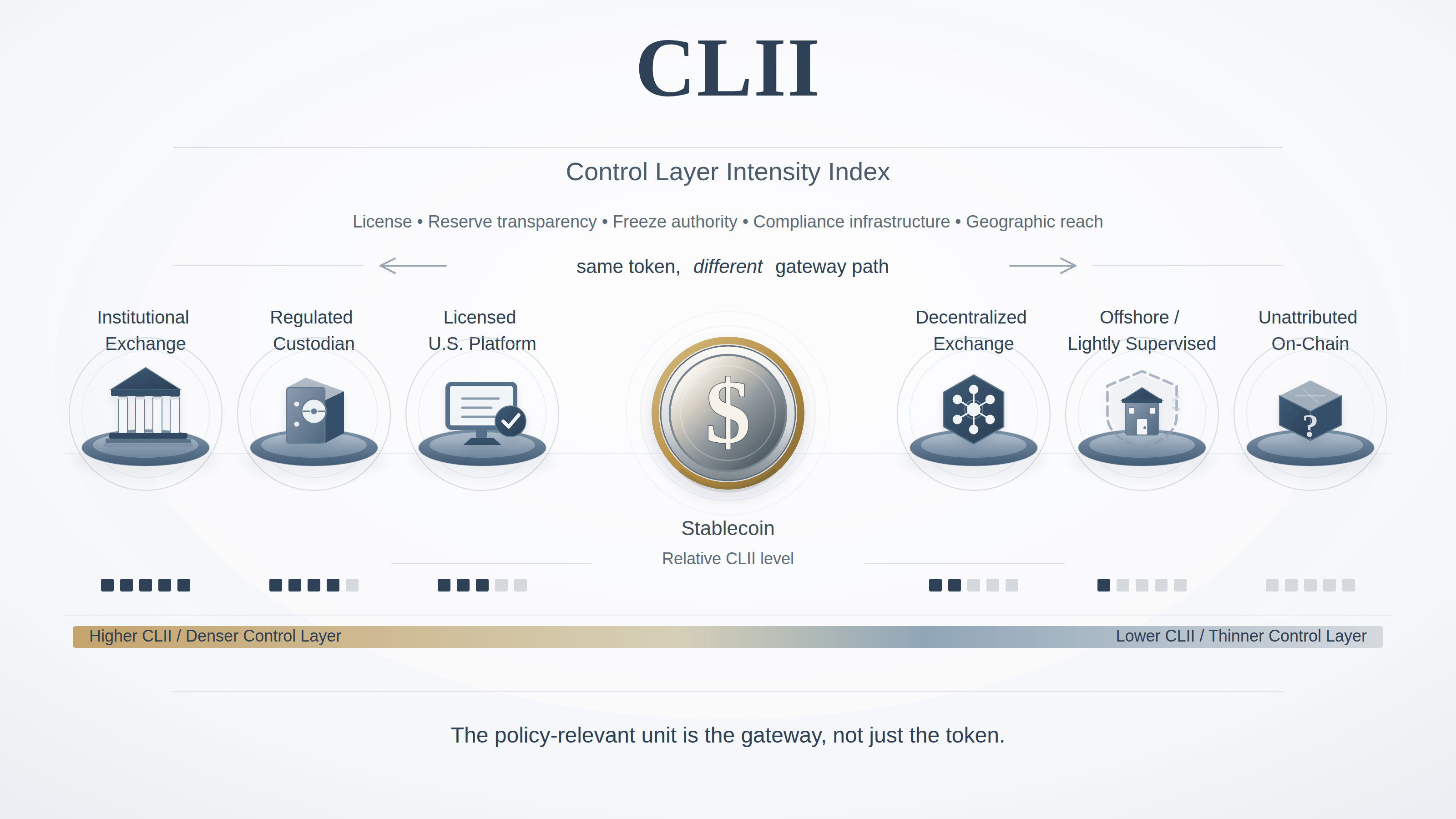
CLII (Control Layer Intensity Index)

Scores regulatory intensity at the gateway layer across five dimensions. The CLII measures who is regulated, not who is fragile: three Tier 1 gateways with near-identical scores produced opposite outcomes during SVB based on entity-specific banking exposure, not token properties.

View CLII framework
MVEP (Minimum Viable Equivalence Pack)

A nine-category diligence framework for testing whether a tokenized product maintains legal, operational, and economic equivalence to the traditional instrument under stress. Each category specifies the required artifact and the pass/fail test. Reverse-engineered from the six failure modes Circle's SVB weekend exposed.

View MVEP framework

Credit Migration Model

Measures where deposit balances sit and how they move. Tracks which bank balance sheets grow, which shrink, and how stablecoin reserve growth changes aggregate credit creation capacity. The policy question: does migration from deposits into stablecoin reserves shrink the lending base that monetary policy operates through?

View Credit Migration Model

Regime Dashboard

Classifies who controls the operating layer right now. Ten signals across routing defaults, sweep ownership, hold authority, fee structures, and disclosure obligations reveal who captures economics, who owns liability, and where the regulator can actually attach obligations in the current regime.

Request Regime Dashboard
Track B Tokenomics and Physical Network Systems (DePIN)
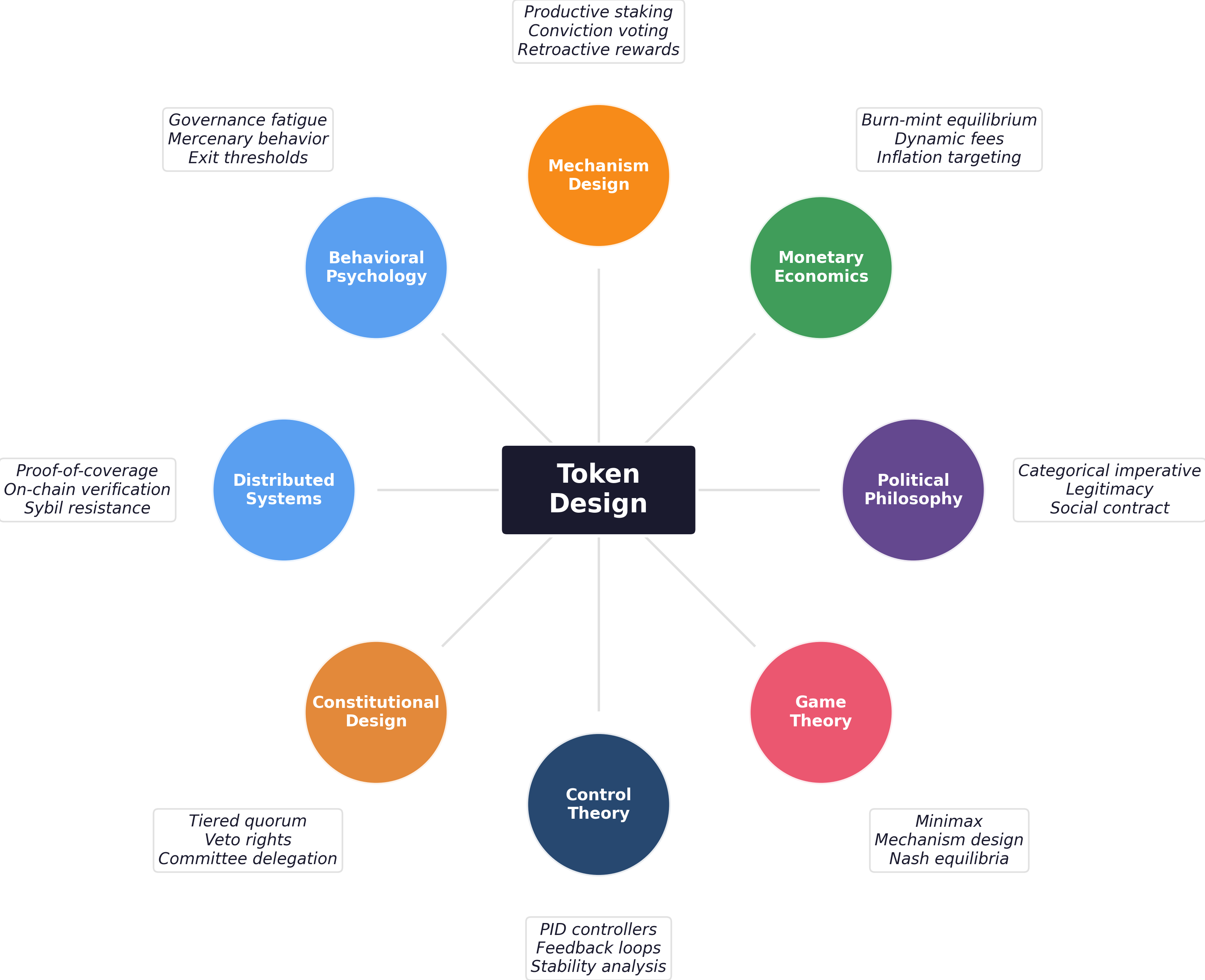
Adaptive Tokenomics discipline map exhibit

Tokenomics & DePIN

Who earns the token matters more than who holds it.

Track B asks whether token economies reward productive contribution or drift into extraction. Each paper specifies the mechanism, stress-tests it under adversarial conditions, and asks whether the design survives contact with real participant behavior.

The anchor study, Adaptive Tokenomics, is a 240-run Monte Carlo simulation testing whether adaptive emission mechanisms sustain participation under adversarial conditions where static schedules collapse.

View the full Tokenomics & DePIN track

Selected Research

Public

Feb 2026 · SSRN · Asset Management / Tokenization

Minimum Viable Equivalence Packs

Circle's $3.3B reserve exposure at SVB broke legal, operational, and economic equivalence simultaneously. A nine-category diligence framework structured around what risk committees ask before approving a tokenized product: rights parity, custody segregation, settlement finality, insolvency posture, governance controls, and continuous monitoring.

Open paper summary
Public / requestable

Dec 2025 · Medium · Policy / Payments / Stablecoins

Dollar v3 / The Control Layer War

Payment stablecoins, tokenized deposits, and tokenized yield products look identical in a wallet but diverge by reserve structure, redemption mechanics, and stress behavior. Maps where GENIUS (enacted) and CLARITY (pending) attach compliance obligations at the control layer. Full control-layer analysis on request.

Open paper summary
Public

2025 · SSRN · Tokenomics / DePIN / Operational Risk

Operational Risk in Token Economies

Slashing, emission decay, and governance concentration are presented as mechanism-design choices. Operationally, they are risk-transfer mechanisms: the validator, the contributor, or the delegator absorbs downside the protocol cannot price correctly in advance. This paper identifies where design fragility concentrates across DePIN token economies and specifies the monitoring thresholds that distinguish adaptive systems from extractive ones.

Open paper summary

About this site

My research program holds itself to the standard it applies to the systems it studies: claims trace to sources, frameworks are tested against adversarial conditions, and boundaries are named explicitly. The site works the same way: transparent structure, named authorship, and evidence the reader can check.

Contact

If you're working on policy, market infrastructure, tokenization, or token-economy design, I'd welcome the conversation.
Tell me what you're building or evaluating and I'll send the most relevant paper, resume version, or supporting material.

Email
I read every email and typically reply within 24 hours.