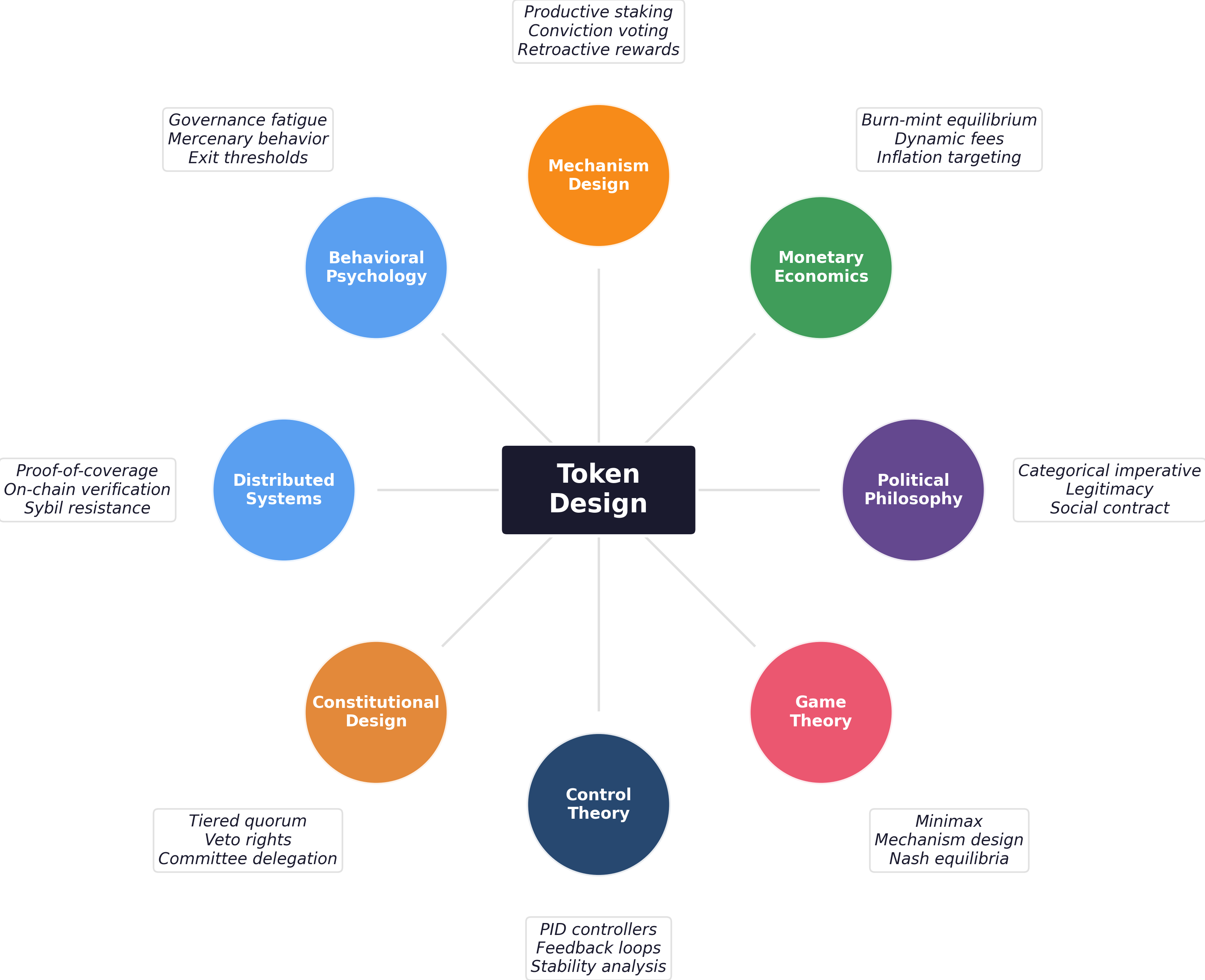
Adaptive Tokenomics: A Systems Engineering Approach to Programmable Incentive Design
Description current as of March 2026.
Token economies can be designed as engineered systems with testable failure modes; a PID-controlled emission system compresses worst-case variance by 6x while static emission's apparent competitiveness masks near-total collapse on other paths.
Adaptive emission functions as insurance: PID compresses worst-case node-count variance by 6x (CV from 0.544 to 0.087 under competitor shock), sustaining 8,880 nodes at the 5th percentile versus 1,049 under static emission.
The advantage is conditional: bull markets produce identical outcomes; the engineering premium emerges only under sustained contraction, where integral wind-up triggers a dilution feedback loop.
Slashing, not emission policy, dominates supply dynamics under ordinary shocks; 240-run Monte Carlo ensemble reveals path dependence that single-seed results mask.
Parameter calibration: MeshNet vs. real DePIN networks
MeshNet is fictional; its parameterization is drawn from operational DePIN networks. Source: Zukowski (2026), Adaptive Tokenomics, Appendix A.
| Parameter | MeshNet | Helium (observed) | Filecoin (observed) | Source |
|---|---|---|---|---|
| Hardware CAPEX per node | $300-500 | $400-600 (hotspot) | $5K-50K (sealing rig) | Manufacturer pricing, 2025 |
| Network contraction | Behavioral exit probabilities | ~76% decline from peak (Q1 2023 to late 2025) | ~8-15% annual provider attrition | Messari; ByteTree 2025 |
| Fee Revenue / Emission Value | <1% (bootstrap) | <5% (2024-2025) | ~10-30% (2025) | Protocol dashboards |
| Governance participation | Reputation-weighted | ~2-5% of HNT holders vote | ~1-3% of FIL holders participate | Governance portal data |
| Token concentration (Gini) | 0.89 (token-weighted) | 0.91 (HNT) | 0.88 (FIL) | Dune Analytics, Jan 2026 |
| OU mean reversion (kappa) | 2.82 | Fitted: HNT daily returns, May 2023 to Feb 2026 | calibration.py | |
| OU volatility (sigma) | 0.049 | Fitted: HNT daily returns, May 2023 to Feb 2026 | calibration.py | |
Key simulation parameters
| Parameter | Baseline | Sweep range | Source |
|---|---|---|---|
| PID proportional gain (Kp) | 0.8 | [0.2, 0.4, 0.6, 0.8, 1.0] | Tuned for stability |
| PID integral gain (Ki) | 0.15 | [0.05, 0.10, 0.15, 0.25, 0.35] | Tuned for stability |
| PID derivative gain (Kd) | 0.2 | [0.05, 0.10, 0.20, 0.30, 0.40] | Tuned for stability |
| Emission Floor / Ceiling | 0.25x / 3.0x base | n/a | Design choice |
| Evaluation interval | 14 days | [7, 14, 21, 30] | Governance cycle |
| Downtime slashing | 0.10 | [0.05, 0.10, 0.15, 0.20] | Helium denylist severity |
| Fraud slashing | 1.00 | [0.50, 0.75, 1.00] | Full-loss design |
| Minimum stake | 10,000 $MESH | n/a | DePIN CAPEX range |
| Node count target (N*) | 10,000 | n/a | Design choice |
Ensemble: 240 runs (30 seeds x 8 configurations) + 566 sensitivity and adversarial runs. Replication: GitHub
What problem it solves
DePIN and token-economy designers need to know whether adaptive emission and slashing policies improve resilience or introduce new failure modes. This paper builds a complete token economy for a fictional DePIN network (MeshNet) and stress-tests it across 240 simulations under four adverse scenarios, with PID-controlled emissions and configurable slashing.
Methods / Data
240-run agent-based Monte Carlo plus 566 sensitivity and adversarial runs. OU price process calibrated to HNT daily returns (May 2023–Feb 2026). Governance data from 12 protocols. 60 PID gain configs, 40 slashing settings, 16 evaluation-interval variants.
Related role profiles
Track B work supports protocol and token-design audiences. For institutional hiring, see Resume and Tokenomics & DePIN track.
Want to discuss this paper? [email protected]