Short on time? Read the 3-minute flagship brief.
Track A: Stablecoin & dollar infrastructure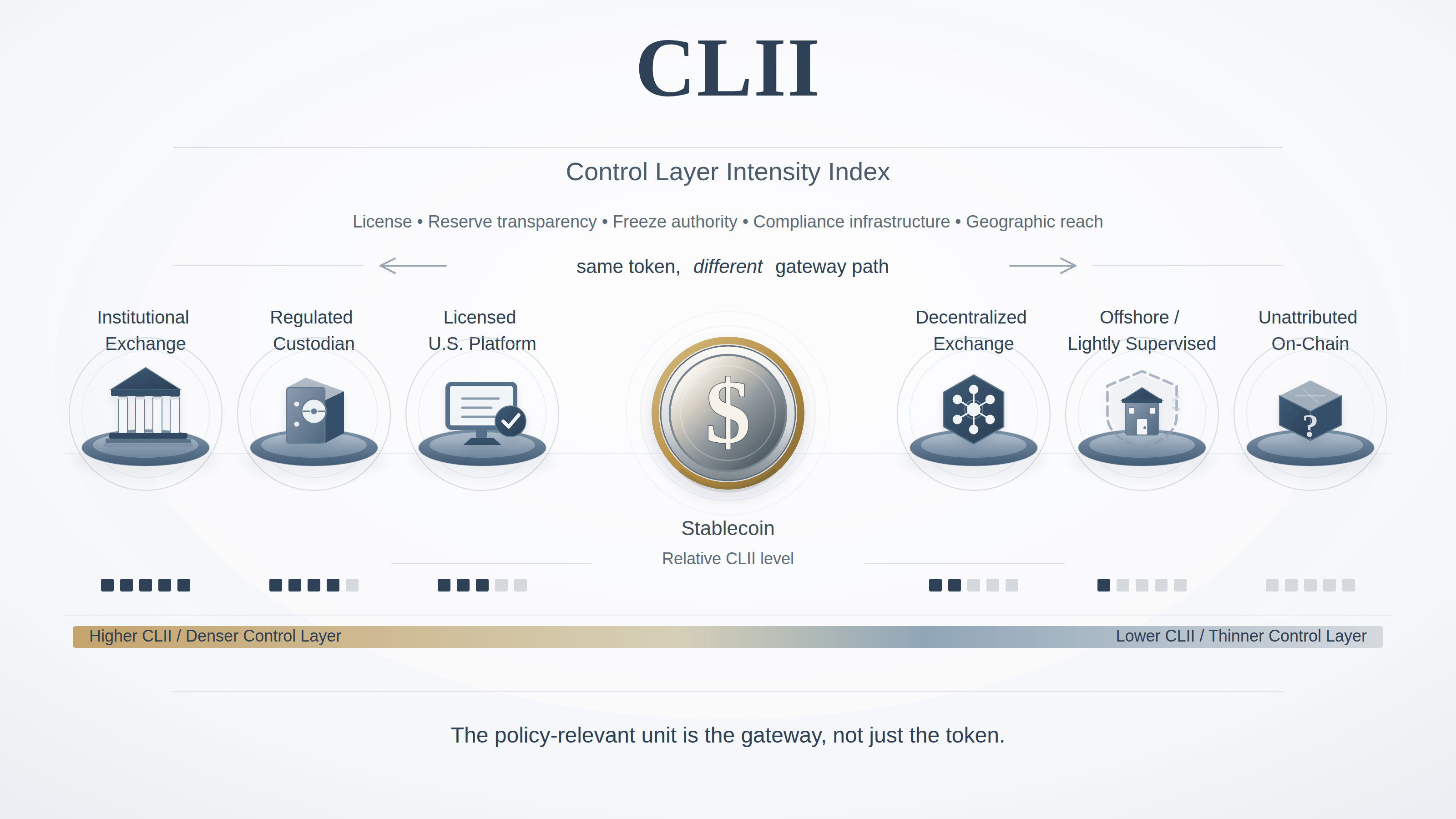
Routing the Dollar: Gateway Infrastructure, Monetary Policy Transmission, and the Dollar's International Functions
Description current as of March 2026.
Whether stablecoins strengthen or weaken the dollar's international functions depends not on the tokens but on the gateways that route them, and those gateways are already more concentrated, less observable, and more systemically coupled than the policy debate assumes.
Stablecoin supply is cointegrated with Fed balance-sheet variables in a regime-dependent pattern; strongest during QT (trace 48.18), weaker during easing (trace 17.71), dollar-specific (absent for Bitcoin or Ethereum), with no significant direct FOMC announcement effects.
The CLII shows that the same dollar token produces materially different regulatory, custody, and concentration outcomes depending on which gateway routes it; gateway-level HHI is 5,021, volume doubled while unique counterparties declined 25%.
Stress behavior is gateway-contingent: the SVB crisis routed capital across dollar gateways while large-scale flight out of dollar-pegged instruments stayed limited; three gateways with zero direct SVB exposure (MakerDAO, Paxos, Gemini) saw their issued instruments (DAI, USDP, GUSD) depeg through code-level reserve dependencies, validating gateway-contingent risk assessment.
Abstract
This paper introduces a gateway-level analytical framework for understanding how dollar-denominated stablecoins interact with Federal Reserve monetary policy and the dollar's international functions. Using a 157-week panel across nine blockchains, a 51-address Ethereum counterparty registry, and Johansen cointegration on a three-variable system (Fed total assets, ON RRP, stablecoin supply), the analysis identifies regime-dependent cointegration consistent with money-market transmission, with direct policy-rate channels playing a weaker role in the data.
The Control Layer Intensity Index (CLII) is a five-dimension scoring regulatory intensity at the gateway layer (Regulatory License 25%, Reserve Transparency 20%, Freeze/Blacklist Capability 20%, Compliance Infrastructure 20%, Geographic Restrictions/Sanctions 15%). Tier 1 above 0.75; Tier 2 from 0.30 to 0.75; Tier 3 below 0.30. The CLII measures who is regulated, not who is fragile. It demonstrates that identical tokens produce divergent regulatory surfaces depending on the routing node. The SVB stress episode traces vertical contagion through MakerDAO's Peg Stability Module; three gateways with zero direct SVB exposure (MakerDAO, Paxos, Gemini) saw their issued instruments (DAI, USDP, GUSD) depeg through code-level reserve dependencies. Application-level flow decomposition covers Ethereum, Solana, and Base (64% of volume), with selection-bias robustness across five checks including Nansen cross-validation (Spearman rho = 0.94).
Related frameworks
Related role profiles
Policy & Market Infrastructure, Stablecoin & Payments Strategy.
Want to discuss this paper? [email protected]