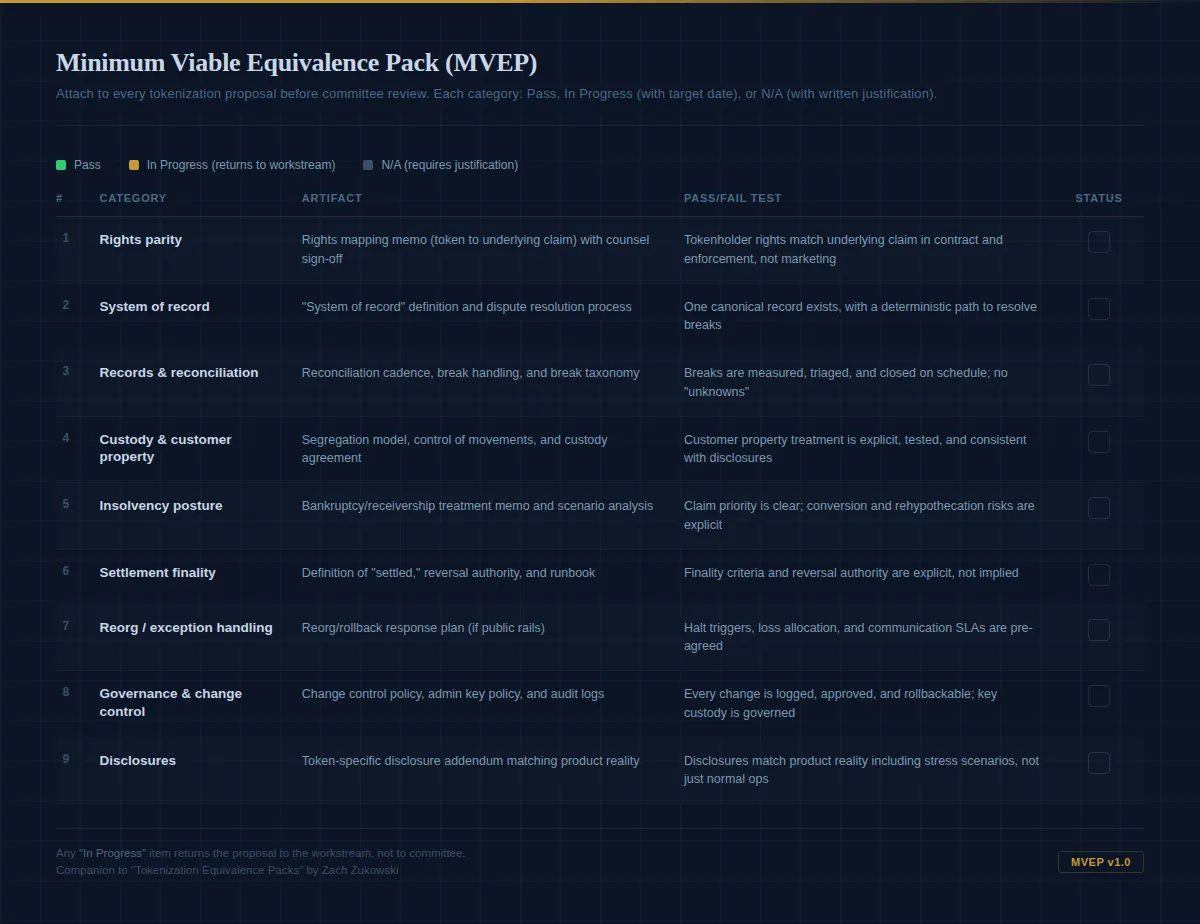
Minimum Viable Equivalence Packs: An Institutional Diligence Framework for Tokenized Products
Description current as of March 2026.
Institutional tokenization diligence fails when it evaluates tokens as standalone assets; the MVEP framework forces evaluation of the nine operational categories where equivalence actually breaks, anchored on the USDC/SVB depeg as the canonical failure case.
Circle's $3.3B reserve exposure at SVB broke legal, operational, and economic equivalence simultaneously, demonstrating that reserve composition risk is a gateway-infrastructure problem.
The nine-category framework (rights parity, custody segregation, settlement finality, insolvency posture, recordkeeping, operational resilience, governance controls, change management, disclosures) replaces ad hoc vendor-pitch diligence with a versioned, comparable checklist.
Continuous monitoring catches equivalence degradation that point-in-time assessments miss.
What problem it solves
Before an institution relies on a tokenized product, it should prove whether the tokenized version preserves equivalence under stress. MVEP is a practical entry gate for tokenized-product diligence, structured around what risk committees actually ask.
Methods / Data
Nine-category framework derived from the USDC/SVB depeg. Anchored on Circle's $3.3B reserve exposure at Silicon Valley Bank.
Related frameworks
Related role profiles
Want to discuss this paper? [email protected]